An Invitation to Rest - The Security Guard
White artist canvases , Mobile phone , Tripod, Microsoft Translator app
Jinji Lake Scenic Area
Suzhou. China
2025
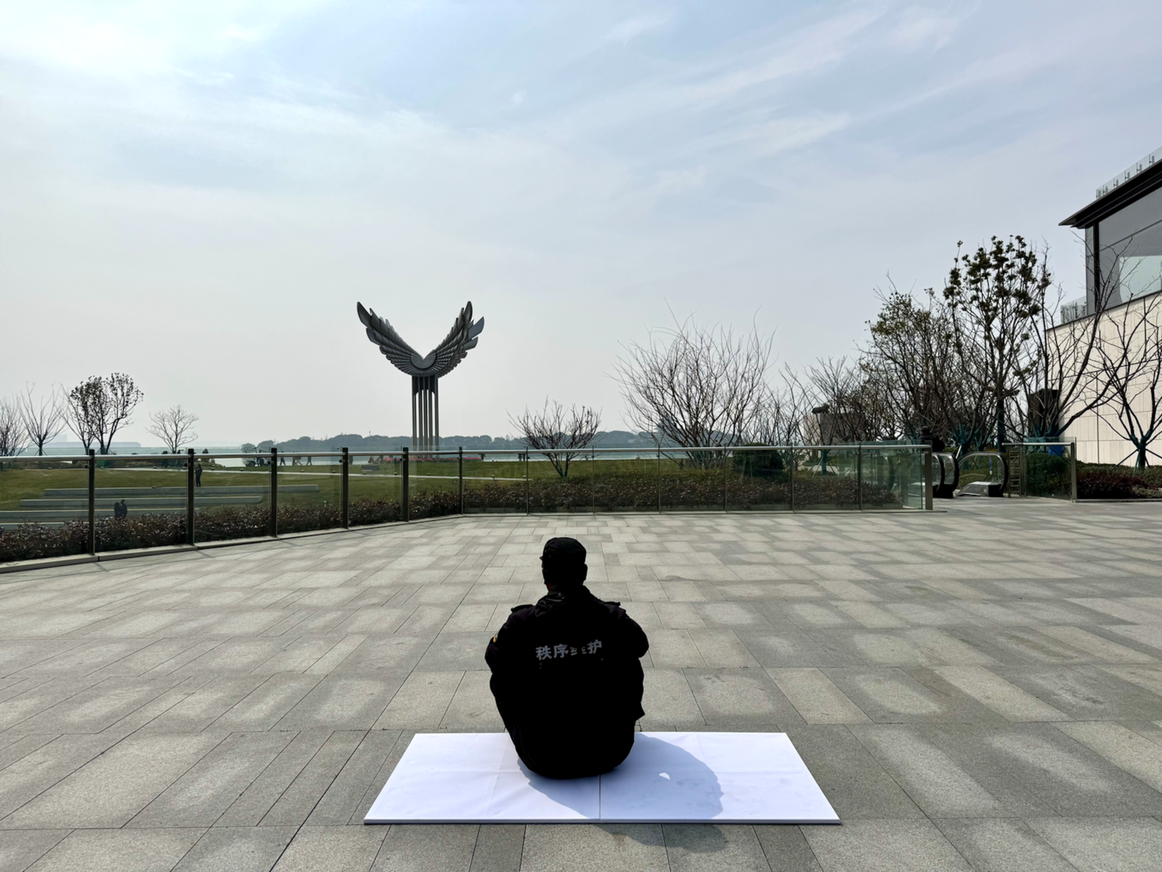
An invitation to a security guard, we asked him to take a moment of rest, with a translator present to bridge communication. What makes it interesting is that the security guard’s choice to sit rather than lie down turns a simple rest break into a visible expression of workplace discipline, hierarchy, and self-surveillance.
A security guard’s role is especially charged here because the job is associated with watchfulness, readiness, and authority. Lying down would signal full disengagement and vulnerability—someone off duty, unavailable, or “idle.” Sitting, by contrast, keeps the body upright, visible, and able to rise quickly. It preserves the appearance of readiness while still accepting the invitation to pause. That is why the text calls it a “cautious compromise”: a momentary break that does not become a complete withdrawal.
It is also interesting because the guard is normally someone who watches others, but here he is also being watched—by supervisors, by norms, by the researcher/translator situation. His posture reveals internalized anxiety about being judged or reprimanded for appearing idle. So the body becomes a site where hierarchical structures show up: even when explicitly invited to rest, he does not fully relax.
Newman’s (2002) phrase—“either for working or relaxing”—captures the ambiguity: sitting is a posture that can belong to either category. For a security guard, that ambiguity is useful. It lets him rest without fully stepping out of the professional role. The detail is interesting because it shows that rest is not neutral: it is shaped by power, surveillance, and the fear of looking unproductive.