These work are experiment:s to tests how long a body can remain lying in a disciplined, non-disruptive posture on a canvas in a busy public space before the public or authorities ask it to move. The duration is therefore variable and determined by that response. The lying-down behaviour on the canvas will stop only when the artist has been told to move and leave the area; at that point, the artist will leave. Until that instruction is given, the artist remains in the soldier posture on the canvas. The action is documented with a mobile phone on a tripod, and the Microsoft Translator app is used to support communication on site.
It invokes the right to rest guaranteed by the Constitution of the People’s Republic of China (National People’s Congress, 2015) and tests how that right appears in everyday public space. It also echoes the foundational ethos of behaviour art (行为艺术) in China. Emerging in the late 1980s, behaviour art positioned the body as a site of inquiry, vulnerability, and resistance, often enacted in non-institutional settings where artists tested the limits of legality, endurance, and social visibility (Berghuis, 2006). As Sun (2022) notes, public space in China is increasingly shaped by design and governance strategies that limit informal or unsanctioned uses. In this context, the resting body on a canvas becomes a quiet resistance—an assertion that rest, like art, belongs in the public sphere.
The work demonstrates the gap between a formal right and its practical exercise: a right can be constitutionally guaranteed yet still be negotiated, questioned, or limited in public space. It makes visible how public space is governed and designed, and it tests tolerance, enforcement, and the boundary between rest and loitering. Because the artist stops only when told to move and then leaves, the work is a respectful negotiation with authority rather than a refusal of it; it makes the moment of being asked visible. Endurance, vulnerability, and social visibility are central to the action, which asks viewers to see public rest as legitimate, visible, and worthy of space.
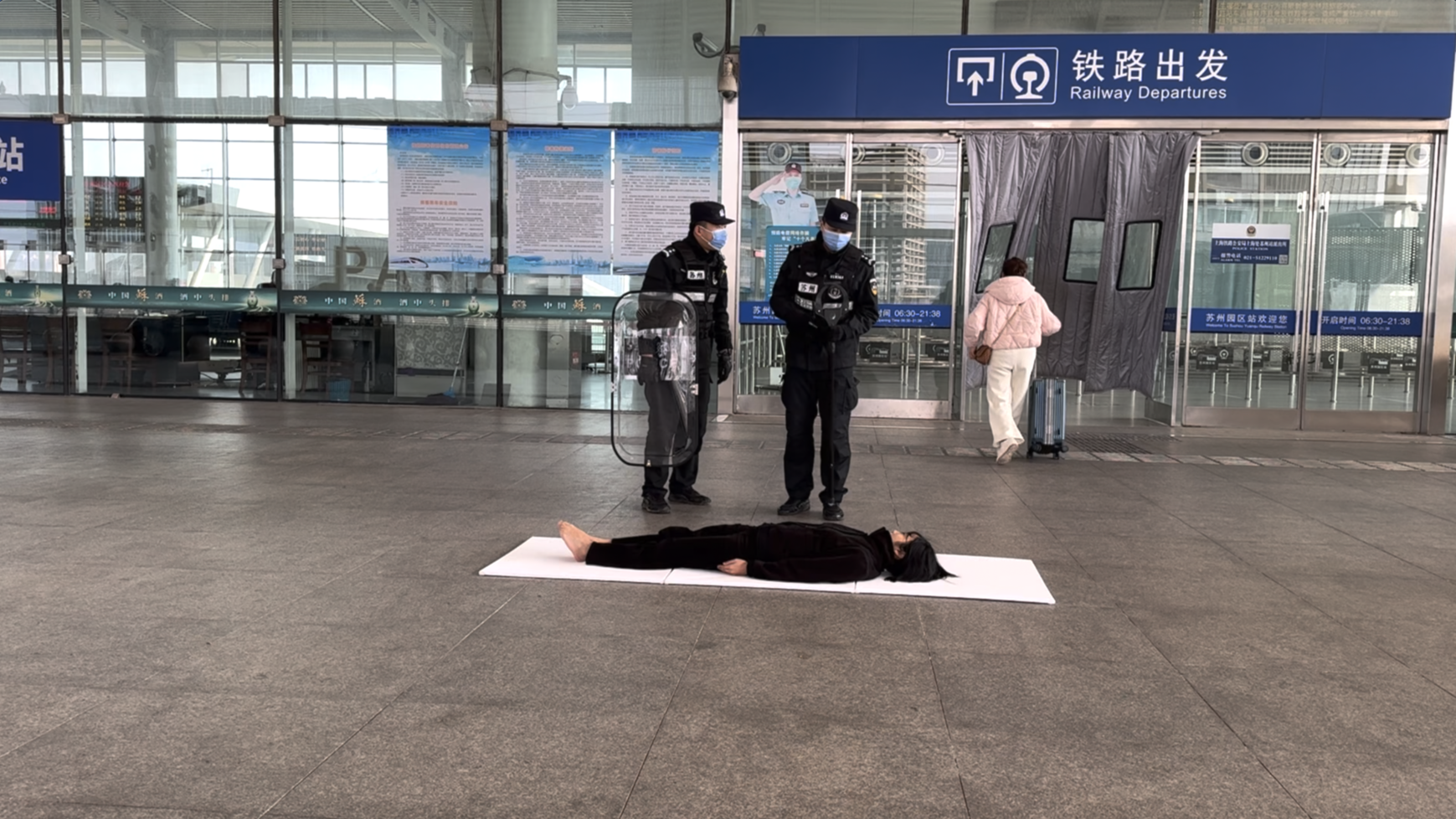
'Right to Rest' - SOLDIER POSTURE
White artist canvases , Mobile phone , Tripod, Microsoft Translator app
Suzhou Railway Station
Suzhou. China
2025
Lying in the soldier position—flat on the back, arms by the sides, legs extended—on top of a white artist’s canvas outside Suzhou Industrial Park Railway Station, in full view of one of China’s busiest public spaces, is a deliberate gesture. The posture is disciplined and symmetrical. It does not block or damage the station; instead, it visibly and respectfully claims space. By framing the resting body on a canvas, the work resists the invisibility of rest in a space designed for transit, speed, and governance, and it reframes the resting body as a site of aesthetic and political engagement.