Bamboo Inhabitant
Bamboo Poles, Artist Clothes
Fuzhou, Jiangxi Province. China
2022
The performance, 'Bamboo Inhabitant' (2022), took place inside the Lucitopia Creative Centre, located in Zixi Valley, Jiangxi Province. Through a sensitive observation the different uses of bamboo by the locals invite me to explore the relationship between the body and architecture through performative actions. The artist behaviour of her everyday movements become the directions to understand the artist's place in the space she is occupying. These performances evolve through the time spent in this new context. The artist, the bamboo, and the artist's clothing, seemingly merge in an ever-changing series of architectural silhouettes. A vernacular dialogue emerged, and processing the everyday observations helped discover this place's characteristics. This vernacular approach enables me to relate on a more comfortable and personal level, guiding me to understand the culture of the people and their context, in which the domestic and the functional is above the public or monumental. The actions are observation taken from the rural environment, the artist re-enacts the utilitarian function of the bamboo poles, tools for drying, hanging, and carrying clothes, and material for construction in fencing and traditional architectural structures. The performance iteration of the humble bamboo brings out the poetic narrative of the simple material. Combine with a soundtrack of audio recordings composed by Mike Gale created from the surrounding Xi Art open-air museum and the local villager's activities.
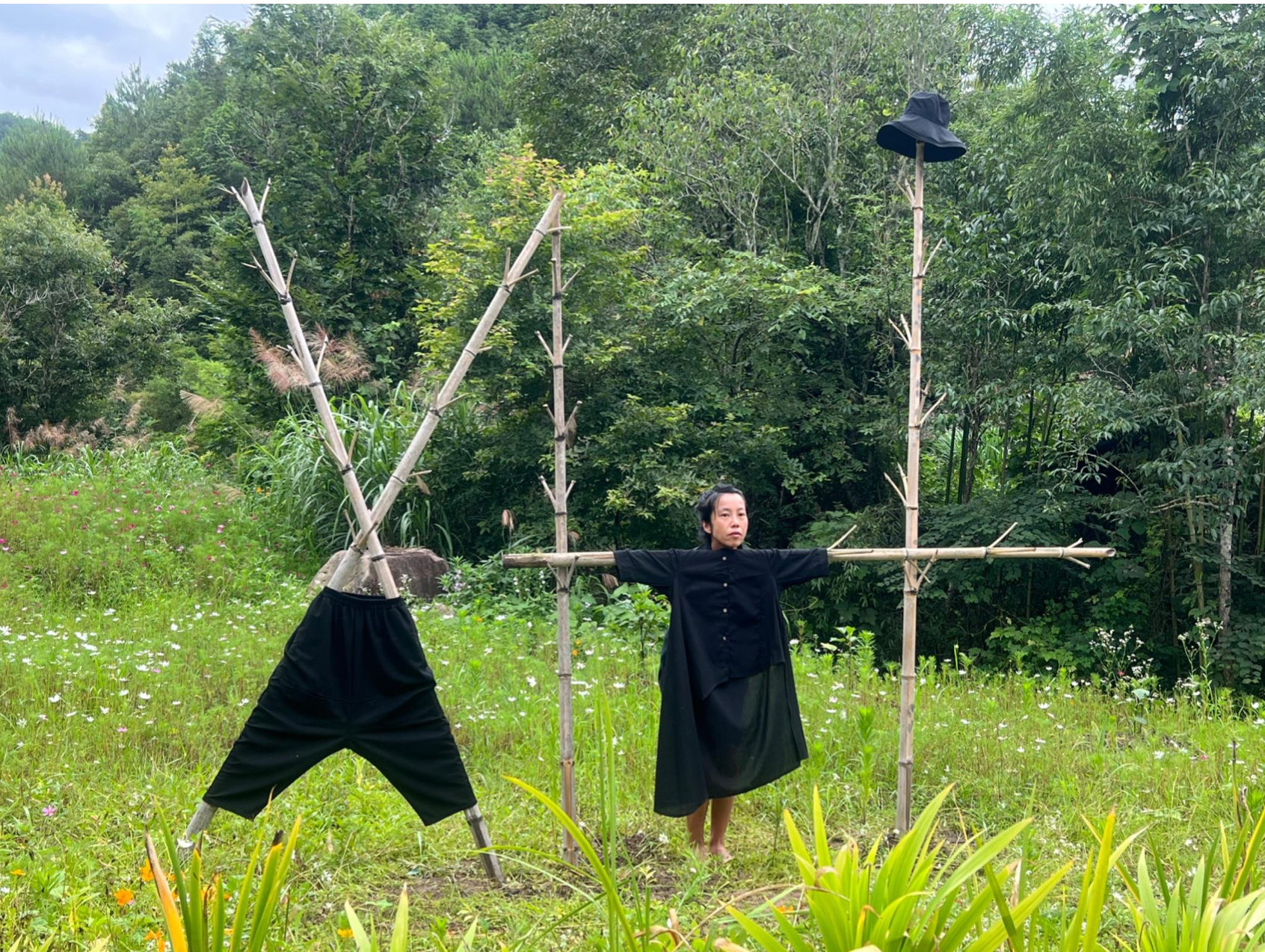
Village Portrait
Bamboo Poles, Artist Clothes
Fuzhou, Jiangxi Province. China
2022
"Village Portrait" is a performative action emerging from the artist’s role of quiet observer, attuning herself to the distinctive rhythms and rituals of local life. She becomes captivated by a simple, pervasive sight: the villagers' use of a particular type of bamboo. This versatile material serves not only as a tool in the fields but as an everyday apparatus for airing and drying clothing outside their homes—a humble yet striking feature of the domestic landscape.
This imagery deepens with the presence of the artist , resembling a scarecrow standing watch over freshly sown fields. In Chinese, they are called 稻草人 (dào cǎo rén) —"rice-straw people"— they echo the silent protagonist of Ye Shengtao's influential 1923 fairy tale collection 稻草人 (The Scarecrow), where the immobile witness becomes a poignant symbol of empathy, helplessness, and quiet observer. Responding to these layered observations, the artist creates a temporary installation using her own black clothing. Bamboo poles are arranged with deliberate intention, positioned to fully stretch each garment: the trousers, the shirt, and most symbolically, a black cotton hat perched high at the very top. This elevated hat transcends its function, becoming a potent symbol of the artist's own imagination—a mind that, while grounded in the rural reality, is always reaching, dreaming, and floating above the clouds.